
Why is electricity price negative — and what does it mean for you?
In 2025, Finland's power exchange electricity price was negative for 447 hours. Many wonder: are we getting paid for electricity now? The answer is usually no. This article explains with calculations and advice on when negative prices are worth taking advantage of.
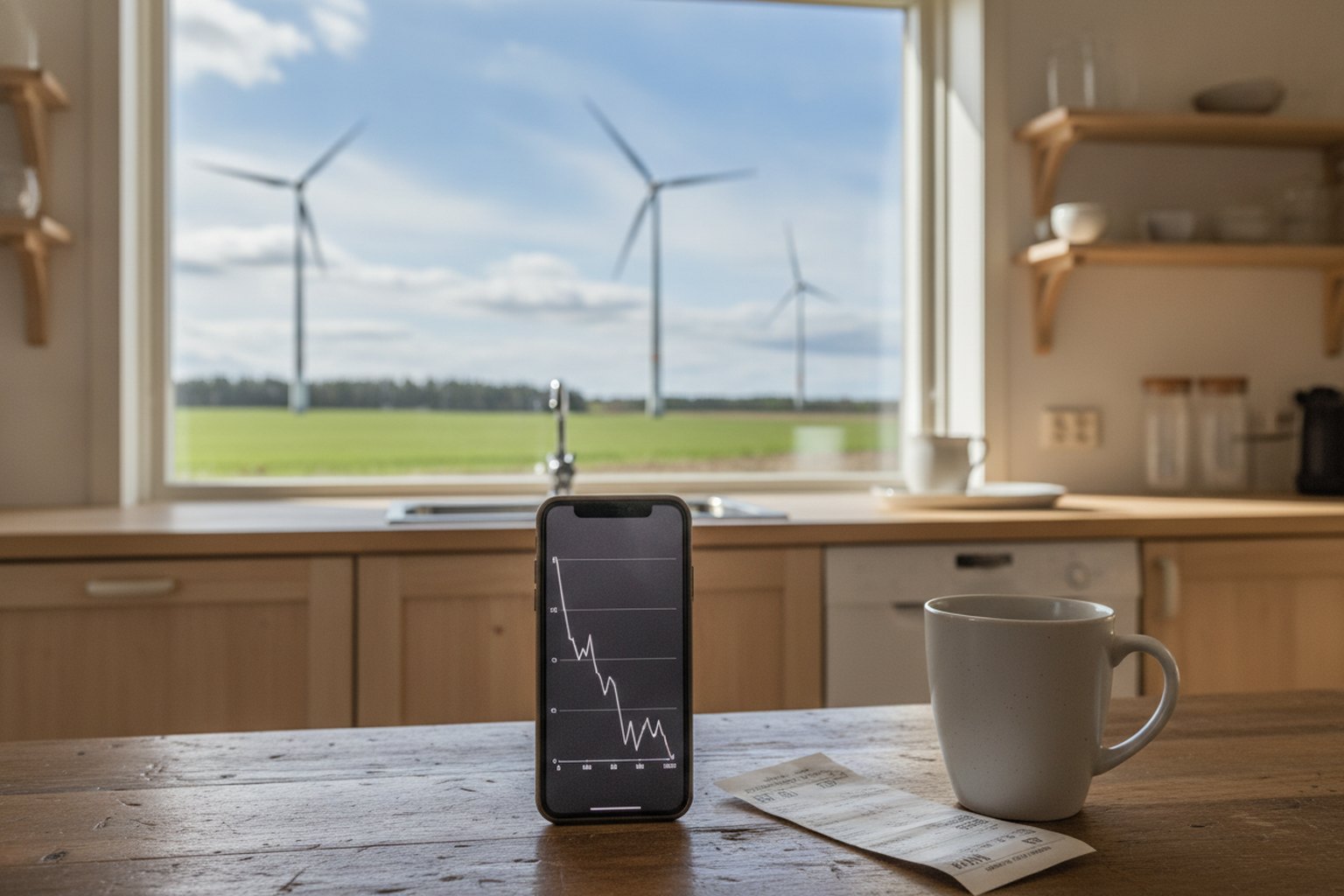
Electricity price on the power exchange was negative for 447 hours in 2025, down from an exceptional 724 hours in 2024. When users check their power exchange apps and see a minus sign on the price, the natural first thought is: am I getting paid for electricity use now? The short answer is no. The longer answer requires understanding what negative prices mean, why they occur, and how they actually show up on your bill.
Why does electricity price go negative?
On the Nord Pool exchange, electricity price is determined by supply and demand. Price goes negative when there is significantly more supply than anyone wants to buy. In practice, this happens in Finland during nights or weekends when wind power is at full production but industry and households are using very little.
Finland's wind power capacity was over 9,400 megawatts by late 2025. Wind turbines don't easily stop just because the exchange price drops below zero. Often it's financially more profitable for a producer to sell electricity at a negative price than to shut down the facility and restart it later. This is influenced by various production subsidies and long-term electricity purchase agreements with price floors.
Nuclear power adds pressure in the same direction: Olkiluoto 3 produces at full capacity around 1,600 megawatts around the clock. Nuclear power plant output can't be reduced quickly, so supply spikes are inevitable during low-demand hours. These two factors — abundant wind power and inflexible nuclear production — have together created the negative price phenomenon in Finland.
How does negative price occur on the exchange?
Nord Pool determines daily prices through an auction where producers submit sale offers and buyers submit purchase offers. When offered volume far exceeds purchased volume, price can fall negative down to a technical floor of −500 €/MWh. This floor became known on November 23, 2023, when Finnish power exchange price crashed to that level due to a trading error. Bloomberg reported that energy company Kinect Energy AS accidentally submitted sales in kilowatts instead of megawatts, resulting in a roughly six thousand megawatt erroneous offer. The Finnish Energy Authority opened an investigation into the case, and subsequently safety mechanisms were added to the market. That day was an exception, but it showed what the trading machinery is capable of in extreme cases.
Do consumers actually get paid when price is negative?
This is the critical question. The answer is: generally no, even when the exchange is negative. This was considered by mofei.life blogger who explained their bill: "Even if the spot price is negative, transmission costs and electricity tax remain, so total cost only decreases. Charges never go below zero."
An electricity bill consists of three parts: energy charge (this can be negative), transmission charge, and electricity tax. The transmission charge goes to the local network company and is always positive, regardless of the exchange price sign. Electricity tax in 2025 was on average 2.25 cents/kWh in household tax class I. These two costs together mean that a negative spot price lowers the bill but rarely or never drops below zero. This is the essential, often overlooked information: you have no margin to get paid for electricity consumption, even when exchange prices are in the minus.
On Suomi24 forum in spring 2025:
"Do we get paid for electricity use when the price is negative? I had to start the washing machine and dishwasher at the same time to get something back."
Suomi24 user, Electricity section, 2025
The answer was clear: you don't get paid. But it's still worth scheduling heavy consumption during those hours because the bill is significantly lower than at any other time.
Calculation: what does a negative hourly price actually cost?
Let's calculate a concrete example. A household has an electric car (charging 13 kWh in one hour), a heat pump (6 kWh hourly consumption), and a hot water tank (3 kWh hourly consumption), all running during the early morning hour when spot price is −0.3 cents/kWh.
| Item | Price/kWh | Consumption | Cost |
|---|---|---|---|
| Spot energy | −0.3¢ | 22 kWh | −€0.066 |
| Transmission charge (average) | 4.0¢ | 22 kWh | €0.88 |
| Electricity tax (class I) | 2.25¢ | 22 kWh | €0.495 |
| Total | 22 kWh | €1.309 |
Transmission charges vary by network company. The 4.0¢/kWh used in this example is typical for Southern Finland. Figures are shown before VAT for clarity.
The energy charge portion is negative, −€0.066. Yet the total remains solidly positive: €1.31 for 22 kilowatt-hours. For comparison, the same consumption during peak time (3-6 PM) might cost €3.50 or more. The savings are thus significant, but it's not "money in your pocket" — it's a smaller bill.
Two contracts, two different outcomes
Negative price benefit depends on your contract. Helen and most power exchange suppliers follow Nord Pool prices directly. Some contracts, however, have a price floor: they partially pass on negative prices or set them to zero. The Finnish Energy Authority's 2025 report shows that demand-side shifting has already occurred significantly, and customers are learning to take advantage of cheap hours. This itself reduces the number of negative hours.
My position: schedule consumption during cheap hours, but don't let your life revolve around it
I believe that taking advantage of negative hours is worthwhile, but with reservations. If you already have a power exchange contract and appliances that support scheduling, savings can be significant. With one washing machine you might save 20-30 cents, but with an electric car or large heat pump 50 cents to a euro per negative hour. Over a year it adds up.
But don't radically change your lifestyle for these hours. Negative hours number at best 400-500 per year, and their timing varies and can't be predicted far ahead. If hunting for negative hours means waking at 3 AM to check prices or keeping appliances on standby ready to start, the savings aren't worthwhile for well-being.
On Murobbs forum the same question came up:
"Is it worth scheduling washing machines and car charging every night for negative hours? How much do you save monthly?"
Murobbs user, 2025
The answer: if your appliances have timers and they run a few times per week on negative prices, savings could be 3-8 euros per month. That's small but requires zero effort. Car charging scheduling is more worthwhile: a 10-15 kWh charge at negative vs. average price saves 2-3 euros per charge, and over a month that could be 20-40 euros.
When are negative hours worth waiting for?
Fingrid Magazine explains that negative prices typically occur at night, weekends, and spring-summer periods when hydropower is abundant and wind blows. Through the Datahub service you can see forecast prices for the coming day: if prices look negative, it makes sense to schedule your washing machine, dishwasher, and car charging for that night. Most modern appliances now have delay timers or can be controlled with smart charging for the cheapest hours.
Sources
- Fingrid Magazine: Is a negative price the new normal? Analysis of negative hours (Tier A)
- Nord Pool: How is the electricity price calculated — pricing mechanism (Tier A)
- Energy Authority: Household electricity bill 2025 (Tier A)
- Bloomberg: Trader error causes huge plunge in Finnish power prices, Nov 23, 2023 (Tier B)
- Energy Authority: Investigation into trading error Nov 23, 2023 (Tier A)
- Mofei.life: Finland electricity pricing explained (Tier C — forum-sourced)
- Helen: Negative electricity price and savings opportunities (Tier B)
- Energy Authority: Demand shifting impacts household electricity bills (Tier A)